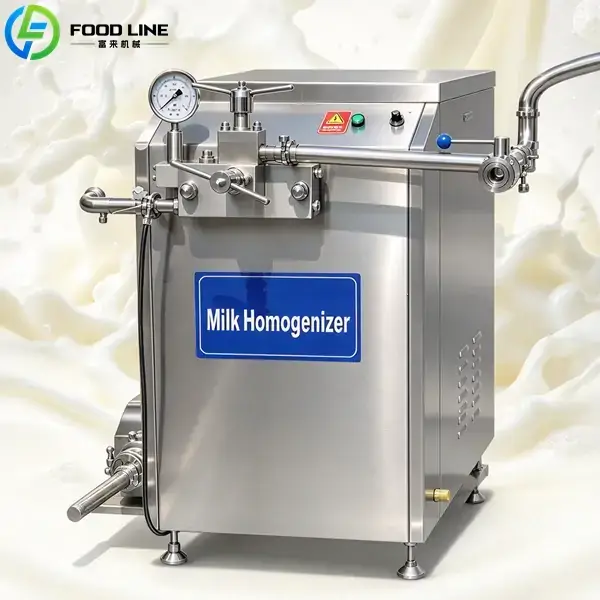
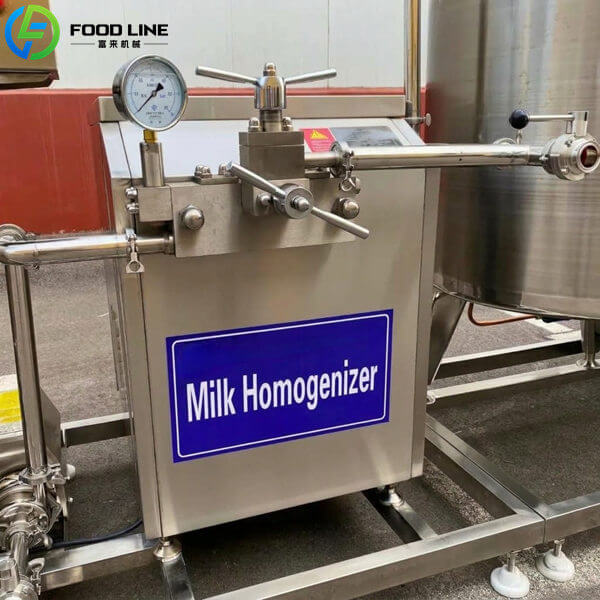
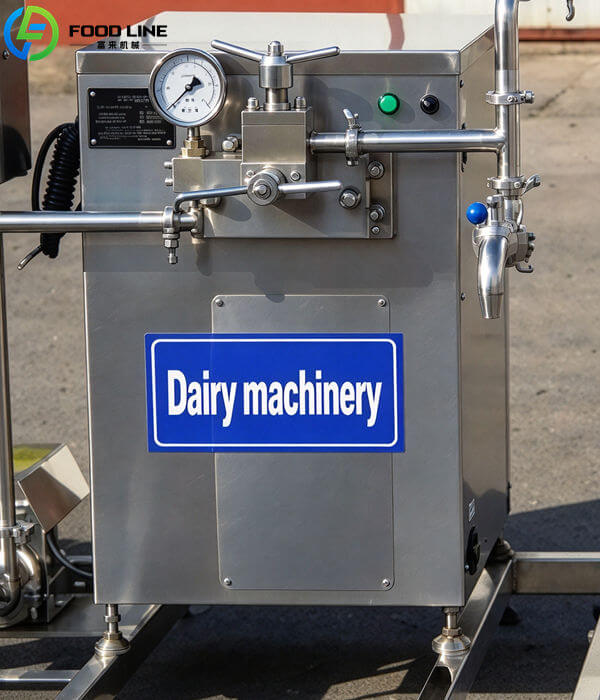
Are you looking for a reliable milk homogenizer for your dairy plant? Foodline supplies homogenizers for global dairy plants. This equipment breaks large fat globules into smaller particles and spreads them evenly through milk. This process helps reduce cream separation and improves milk texture. Food manufacturers use milk homogenizers to process fresh milk, yogurt, flavored milk, and other dairy products. As an equipment manufacturer, we welcome your inquiries.
Get a Factory-Direct Quote on Milk Homogenizers
milk homogenizer for dairy product manufacturers
Foodline Milk Homogenizer for Sale
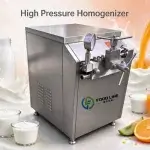
As a key device in dairy processing lines, the milk homogenization machine uses high pressure to reduce the size of fat globules in milk. It helps create a finer texture and a more even fat distribution.
This high pressure homogenizer is commonly used near the heat treatment stage in dairy processing. Depending on the production process, it can work with pasteurization or UHT treatment equipment.
Milk homogenizers can meet varying capacity requirements, ranging from small-scale dairy workshops to large-scale processing plants. As a direct supplier, Foodline Machinery can assist you in selecting the ideal model based on your production needs.
The high pressure homogenizing machine uses a pump and a homogenizing valve to process milk. The process involves the following four main steps:
Feeding: Preheated milk enters the equipment.
Pressurization: A high-pressure pump forces the milk toward the homogenizing valve.
Fat Globule Breakdown: Milk passes through a narrow gap at high speed; shear forces and turbulence break large fat globules into tiny particles.
Uniform Distribution: The tiny fat globules are evenly distributed throughout the milk, thereby reducing fat separation during storage.
The homogenization pressure depends on the type of milk and product quality requirements. Proper preheating also helps achieve optimal homogenization results.
Role of a Homogenizer Machine in Yogurt Production Lines
In yogurt production, the milk homogenization equipment breaks down fat globules, thereby improving the uniformity and texture of the fermented milk base.
A typical yogurt production process flow is as follows:
Raw milk → Filtration → Preheating → Homogenization → Pasteurization → Cooling to fermentation temperature → Inoculation with starter culture → Fermentation → Cooling → Filling
When selecting a milk homogenizer for a yogurt production line, factors such as milk processing capacity, homogenization pressure, feed temperature, and product type must be considered.
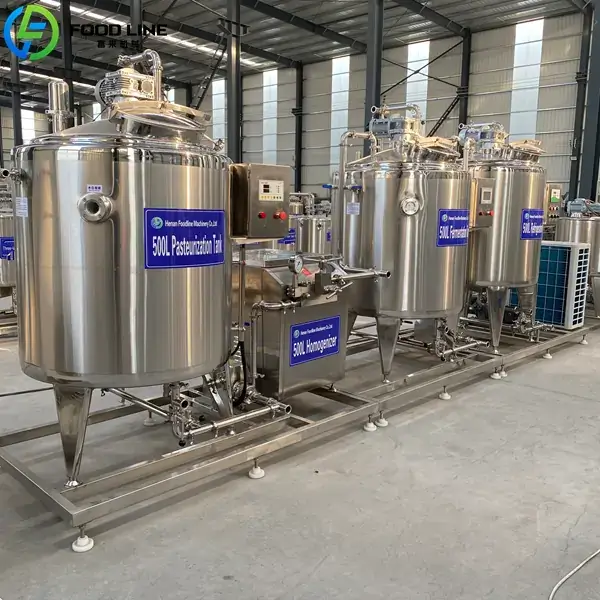
Foodline can configure a complete yogurt making machine line based on your target output. Let us know your capacity requirements, and we will recommend the optimal configuration for you.
Need More Than a Homogenizer? Request a Complete Yogurt Processing Line Layout
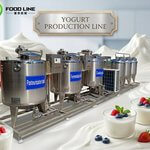
300l yogurt processing line
FAQs
1. What is the operating temperature for milk homogenizers?
The milk temperature should stay between 40°C and 60°C. Homogenization is ineffective at low temperatures, so the milk must be preheated beforehand.
2. What pressure is required for milk homogenizers?
Typically 20–60 MPa.
3. Does “milk skin yogurt” (cream-topped yogurt) require homogenization?
No. Producing “milk skin yogurt” requires preserving the cream layer, so the milk should not be homogenized. Homogenization would prevent the formation of this layer.
Inquire Now – We’ll Reply Within 24 Hours
Foodline: Milk Homogenizer Manufacturer in China
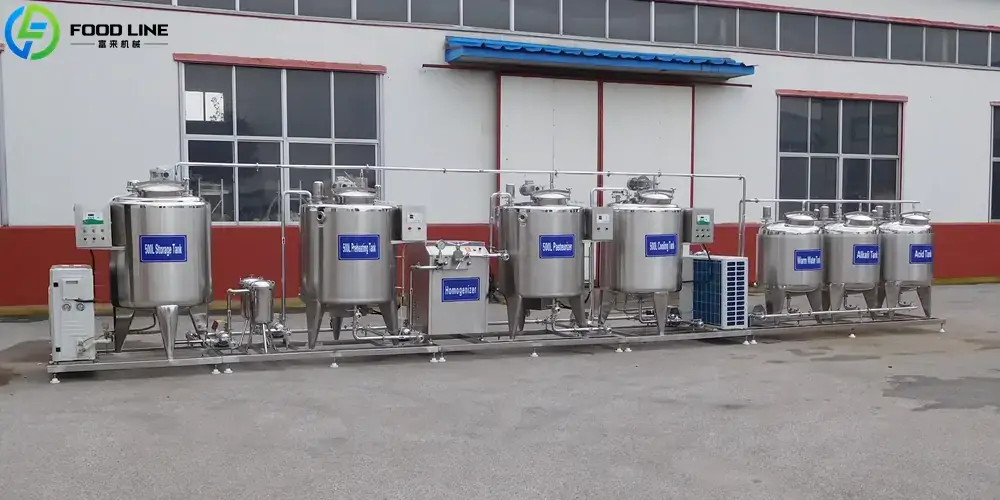
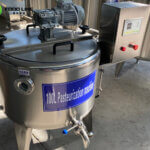
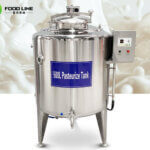
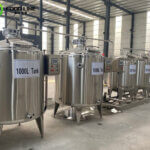
Foodline Machinery is a Chinese manufacturer that researches, develops, produces, and exports a wide range of food processing equipment. Our yogurt production equipment includes cooling tanks, preheating tanks, homogenizers, pasteurization tanks, fermentation tanks, and CIP cleaning systems.
We have supplied our yogurt making machines to clients in Liberia, South Africa, the United States, France, and the Philippines. As a factory-direct supplier, we can assist you in selecting the right equipment based on your production capacity, yogurt varieties, and processing requirements.
If you are planning to procure a milk homogenizer for your dairy or yogurt plant, contact Foodline with the following information:
Target processing capacity per batch/hour
Types of dairy products you plan to produce
Available voltage and specific production line requirements
Our team will recommend suitable equipment and provide a quotation for your review. We can also discuss complete yogurt production line configurations if you need other equipment for milk preparation, heating, fermentation, cooling, and filling.
We use cookies to ensure that we give you the best experience on our website. If you continue to use this site we will assume that you are happy with it.